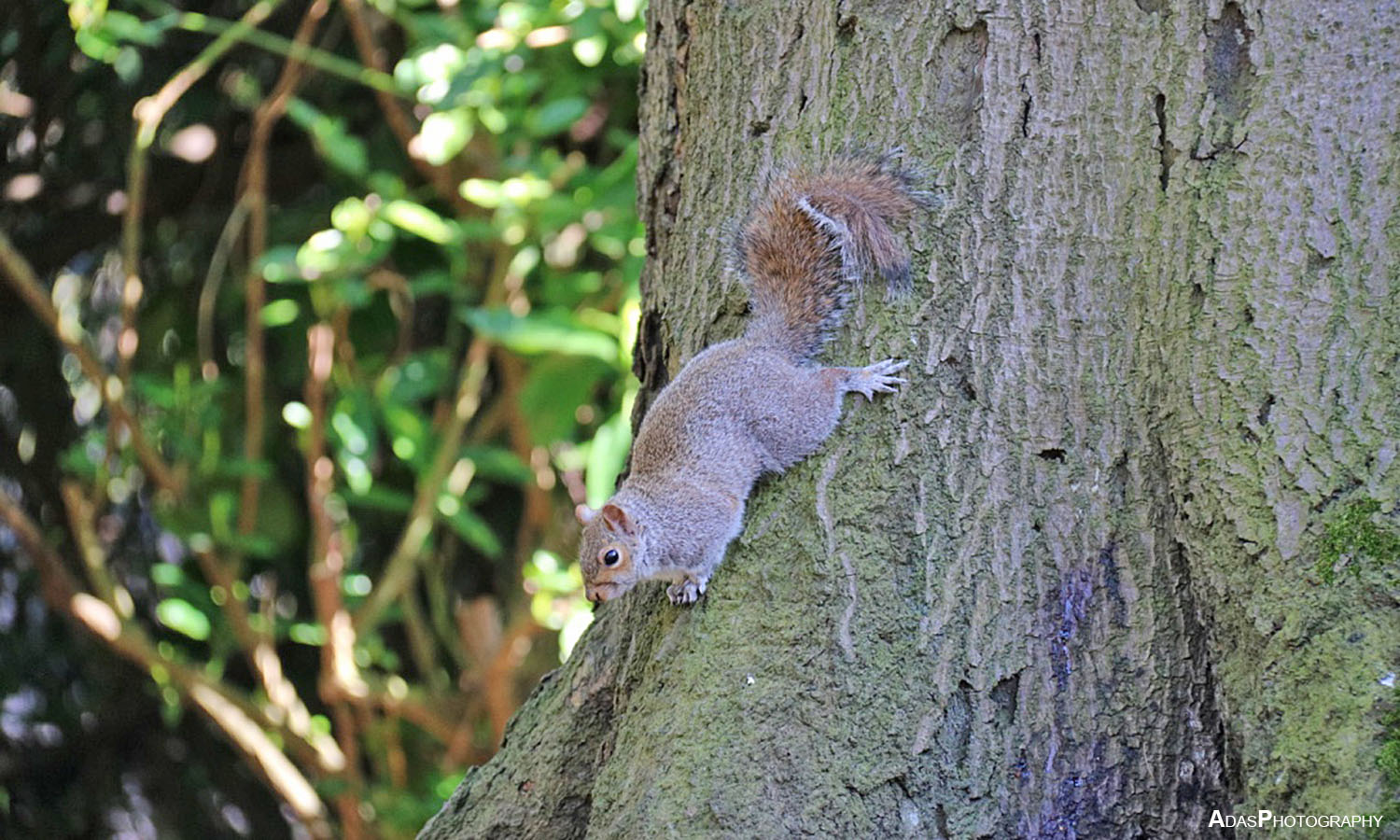
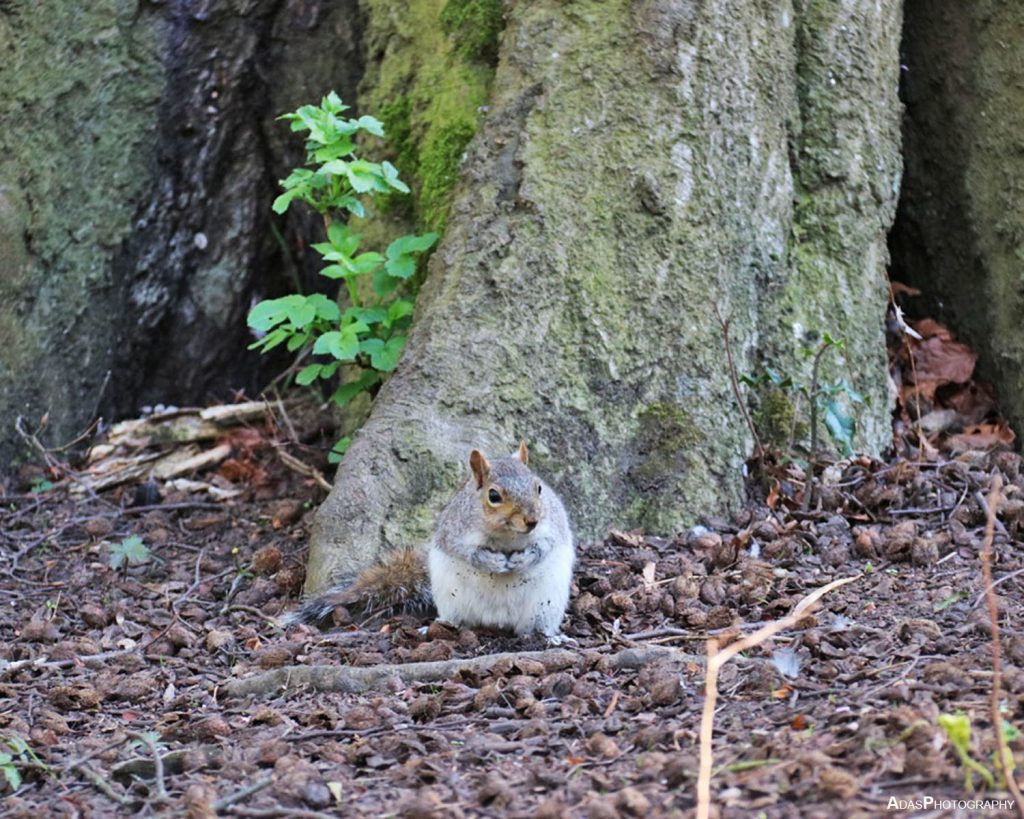
I found this appealing wild grey squirrel or scientifically known as Sciurus Carolinensis somewhere in the wood when I had a smooth walked in there. Even though this creature are lovable beware they have an incredible senses to detect their predators. They also have very accurate spatial memory for the locations of their caches, and use distant and nearby landmarks to retrieve them.
Grey Squirrels use deceptive behaviour to prevent other animals from retrieving cached food. What they do is they will pretend to bury the object if they feel that they are being watched (Clever squirrels, aren’t they). They do this by preparing the spot as usual, for instance, digging a hole or widening a crack, miming the placement of the food, while actually concealing it in their mouths, and then covering up the “cache” as if they had deposited the object (I like these tricks). They also hide behind vegetation while burying food or hide it high up in trees (if their rival is not arboreal).
Grey squirrel is one of very few mammalian species that can descend a tree headfirst. It does this by turning its feet so the claws of its hind paws are backward pointing and can grip the tree barkexample in the photo above.
Grey squirrels build a type of nest, known as a grey (The origin of the word “drey” is unknown, but has been traced in English to the early 17th century), in the forks of trees, consisting mainly of dry leaves and twigs. The dreys are roughly spherical, about 30~60 cm in diameter and are usually insulated with moss, thistledown, dried grass, and feathers to reduce heat loss.
Well, here is the fact that I thought quite astonished myself where I found out the story about a grey squirrels attracted the attention of a gentlemen travelling in America during 19thcentury, who decided that they would be an “aesthetic addition to the fauna of the British countryside” (Laidler, 1980). Laidler (1980) cites records of Grey Squirrels in Britain as early as 1828, but says these seem to have disappeared. All authors agree that the first recorded successful introduction was in 1876, when Mr T. V. Brocklehurst released four Grey Squirrels from the USA into Henbury Park, near Macclesfield, Cheshire. In 1889, Mr G. S. Page released five Grey Squirrels into Bushey Park, Middlesex, but this introduction was apparently unsuccessful, so he tried again, importing 10 squirrels from the USA in 1890, which were released at Woburn Abbey, Bedfordshire, by the 9th Duke of Bedford. Grey Squirrels continued to be imported and translocated into new sites across Britain until at least 1929, and probably up to 1937, with 32 recorded introductions altogether (McRobie, 2012). Laidler (1980) suggests that it almost became a ‘fad’. In common with other wild fauna, they were also kept as pets (Oh dear…). This is a part of the reason why red squirrels originally from Britain, Ireland and Italy usually began to disappear because grey squirrels carry a disease, a Parapoxvirus, which does not appear to affect their health but often kills red squirrels. Grey squirrels are more likely to eat green acorns, so will decimate the food source before reds get to them. Reds favour the green acorns because they are less able to digest the polyphenols in mature acorns. When red squirrels are put under pressure they will not breed as often (poor Red Squirrels).
P/S: I will try harder to find Red squirrel on my next journey and I will write about them in my next article soon. Stay tuned…